
The Methanol Industry in Trinidad began
with the construction of a 1,200 MT per day state-owned methanol
plant in 1983 (Trinidad and Tobago Methanol Company’s
first plant). Since that time, the industry has expanded
to include six larger plants with an annual production
capability close to 6 million MT of methanol.
At the MHTL Point Lisas Methanol Complex, methanol
is made using the ICI Low Pressure Methanol Synthesis
Process. The two main raw materials used are natural
gas (96% methane) received from the National Gas Company
(NGC) to provide the carbon and hydrogen components
and water from from the Water and Sewerage Authority
(WASA) to provide the oxygen component. These raw materials
undergo a series of chemical reactions to produce crude
methanol which is then purified to yield refined methanol,
having a purity exceeding 99.9%.
The plants operate continuously 24 hours a day in a
production process that can be divided into four main
stages: Feed Purification, Reforming, Methanol Synthesis
and Methanol Purification as shown in the flowsheet
below:
STEP 1 : FEED PURIFICATION
The two main feedstocks, natural gas and water, both
require purification before use. Natural Gas contains
low levels of sulphur compounds and undergo a desulphurization
process to reduce, the sulphur to levels of less than
one part per million. Impurities in the water are reduced
to undetectable or parts per billion levels before being
converted to steam and added to the process. If not
removed, these impurities can result in reduced heat
efficiency and significant damage to major pieces of
equipment.
STEP 2: REFORMING
Reforming is the process which transforms the methane
(CH4) and the steam (H2O) to intermediate reactants
of hydrogen (H2), carbon dioxide (CO2), carbon monoxide
(CO). Carbon dioxide is also added to the feed gas stream
at this stage to produce a mixture of components in
the ideal ratio to efficiently produce methanol. This
process is carried out in a Reformer furnace which is
heated by burning natural gas as fuel.

STEP 3 : METHANOL SYNTHESIS
After removing excess heat from the “reformed gas”
it is compressed before being sent to the methanol production
stage in the synthesis reactor. Here the reactants are
converted to methanol and separated out as as crude
product with a composition of methanol (68%) and water
(31%). Traces of byproducts are also formed. Methanol
conversion is at a rate of 5% per pass hence there is
a continual recycling of the unreacted gases in the
synthesis loop.

This continual recycling of the synthesis
gas however results in a build-up of inert gases in
the system and this is continuously purged and sent
to the the reformer where it is burnt as fuel. The crude
methanol formed is condensed and sent to the methanol
purification step which is the final step in the process.
STEP 4 : METHANOL PURIFICATION
The 68% methanol solution is purified in two distinct
steps in tall distillation columns called the topping
column and refining column to yield a refined product
with a purity of 99% methanol classified as Grade AA
refined methanol.
The methanol process is tested at various stages and
the finished product is stored in a large secured tankage
area off the plant until such time that it is ready
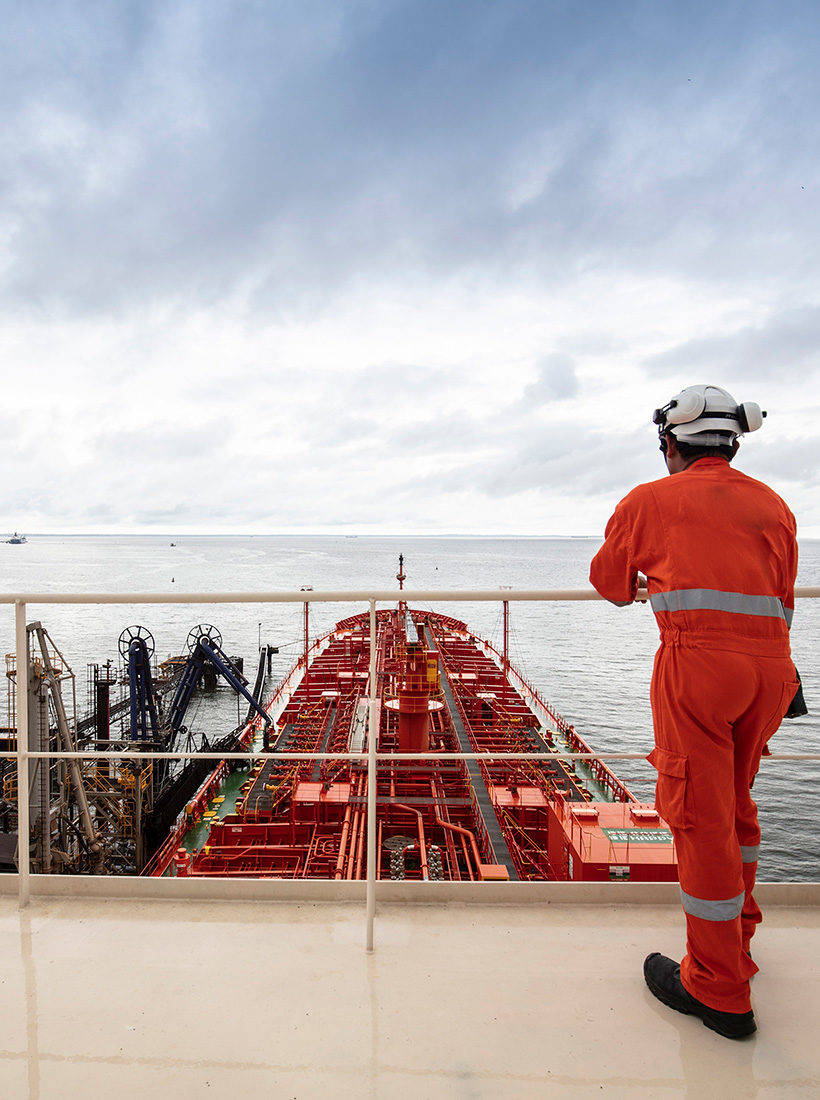
to be delivered to customers. Since 99% of our product
is sold on the overseas market, it is shipped by ocean
going tankers while local sales are made via pipelines
and drums.
|